Build Roads, Not Walls: Security Lessons from the Internet’s Early Days
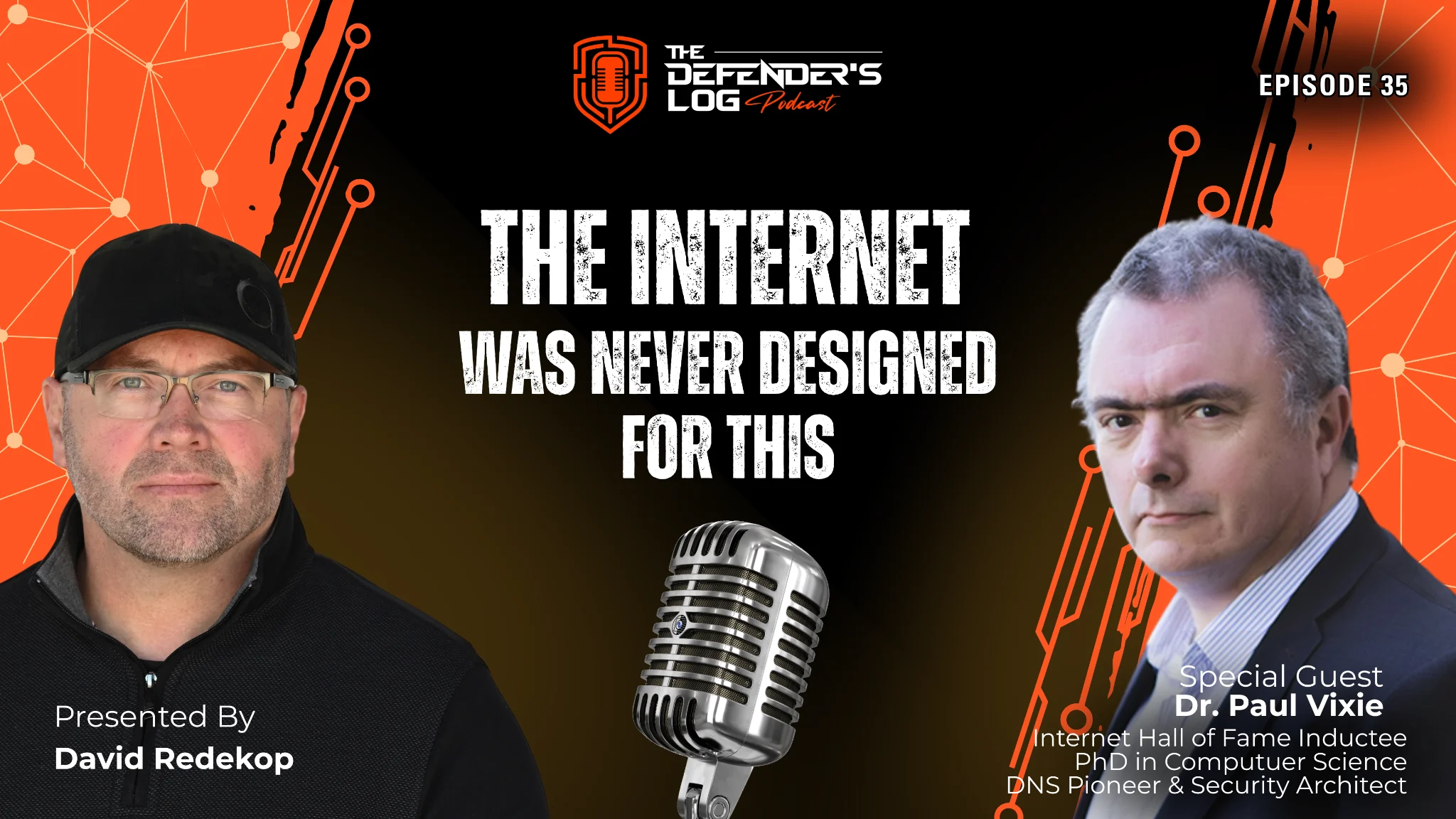
When pioneers built the early internet, they operated with what Internet Hall of Fame inductee Dr. Paul Vixie calls “criminal naivete.” The network was an exclusive bubble of universities and government agencies where everyone was trusted, passwords traveled in clear text, and cybercrime didn’t exist.
Today, that foundational trust is routinely abused. On The Defender’s Log, Vixie explained how cybersecurity has evolved into an economic “forever war” where defenders and attackers constantly try to drive up each other’s costs.
Here are three takeaways from Vixie on defending modern networks:
- DNS is the ultimate choke point: Nearly every digital interaction—good or bad—starts with a Domain Name System (DNS) lookup. By creating DNS Response Policy Zones (RPZs) and tracking newly observed domains, defenders can block malicious connections before a handshake even occurs, stopping threats without needing endpoint agents.
- Beware of blinding defenders: While encrypted DNS was designed to protect user privacy from surveillance, Vixie warns it strips network administrators and parents of the visibility needed to enforce local security policies—forcing defenders into increasingly complex workarounds.
- Complexity favors the attacker: Over-engineering security stacks carries a steep price. As Vixie notes, the more complicated a system becomes, the more likely an attacker’s AI swarm will understand it better than you do.
Ultimately, Vixie’s core philosophy remains simple: “Build roads, not walls.” While defensive barriers are necessary, true progress comes from enabling secure, open infrastructure rather than relying on blockades alone.
TL;DR
- Early Naivete: The internet was built for a small, trusted group of academics. It wasn’t designed to stop today’s cybercriminals.
- Roads Over Walls: Purely blocking threats is a losing battle. Lasting success comes from building open, secure infrastructure.
- DNS Stops Attacks Early: Every online connection starts with a DNS lookup. Blocking bad domains there stops threats before they connect.
- Drive Up Attacker Costs: Cybercrime is an economic war. Defenders must make attacks too expensive to run by blocking newly active domains.
- Encrypted DNS Blinds Defenders: Privacy tools like encrypted DNS strip parents and admins of local control. This forces them into clunky workarounds.
- Simplicity Wins: Complex security stacks backfire. If your system is too complicated, an attacker’s AI will understand it better than you do.
Links
View it on YouTube: https://www.youtube.com/watch?v=g0Ke6e2pokU
Listen to the episode on your favourite podcast platform:
Apple
Spotify
https://open.spotify.com/episode/1O6kl1W5hg2rlHKskBoXlf
Amazon Music
ADAMnetworks
Episode 35 - Full Transcript
Paul: The criminal naivete was that in those early days, the network did not have untrusted people on it or untrusted software on it. All wars about economics, the sides continue until at least one of them cannot afford to continue. So everybody’s trying to drive their own costs down and the other guys’ costs up. The most important thing, which is: build roads, not walls. I mean, you’re going to need some walls, but don’t count on walls alone. The more complicated it is, the more likely that an AI swarm belonging to your attacker will be able to understand it and you will not.
Show Intro
Announcer: Deep in the digital shadows, where threats hide behind any random byte, a fearless crew of cybersecurity warriors guards the line between chaos and order. Their epic battles? Rarely spoken of until today. Welcome to The Defender’s Log, where we crack open the secrets of top security chiefs, CISOs, and architects who faced the abyss and won. Here’s your host, David Redekop.
Welcome to The Defender’s Log
David: Welcome back to The Defender’s Log where we break down the architecture, strategy, and real world realities of keeping complex systems secure. And today’s guest isn’t just someone who understands how the internet works. He’s one of the people who built its foundational plumbing, if you will. Dr. Paul Vixie is an Internet Hall of Fame inductee, the primary author and architect behind BIND 8, and the creator of Vixie cron over a career spanning decades from founding the Internet Systems Consortium, pioneering early anti-spam defenses with MAPS, to founding Farsight Security and securing and serving as a distinguished engineer and VP at AWS, that’s Amazon. Paul has been at the center of internet infrastructure and security for some time.
And most importantly for our conversation today, Paul is the co-creator of DNS response policy zones, RPZs, or RPZ as some English countries call it. The breakthrough that transformed DNS from a simple phone book into real-time programmable security control plane. And Paul, we are on the same page on all of these things and it’s an absolute honor to have you on The Defender’s Log today.
Paul: Well, I’ve been following your work for years and finally I’m happy to finally be part of it.
David: Well, I’m genuinely pleased to know that you’ve been following some of it. I know that we’re all of it. I know that the early days when we had conversations about it, I was really a newbie, right? I still remember the day I showed up to my ISP and with a box to collocate and he wanted to have my zone file and I said, “What’s a zone file?” And that was my start into the world of DNS and boy, how far we’ve come.
Paul Vixie’s Journey into Internet Infrastructure
David: But you famously described, let’s talk about your career for a minute, because I think people are genuinely interested. We have a number of students in cybersecurity and we have a next generation that is looking to get into this space that are listening to some of our guests. You described your career as coming from the Journal of Irreproducible results.
Paul: Yes I have.
David: And you went from dropping out of high school to earning a PhD at Keio University. By the way, I did not understand until I looked at this that their entire program can be done in English or did you have to learn Japanese?
Paul: I did it in English but I ended up learning a smattering of Japanese because the other students who wanted to do the whole thing in English sort of needed some coaching. And so, you know, when I was during the month-long visits to Keio over that period of years, I spent a lot of time with other students, but in my program, every student has to write and defend their thesis in English. And that was just Japan’s recognition that in the tech industry, somebody who can only speak Japanese would be at a disadvantage.
David: Right. And it seems to have gone by that de facto standard in places like Germany and Holland as well. You don’t meet any internet security architect that isn’t as fluent in English as if English was their native tongue, right? But that’s interesting.
Why the Early Internet Was Built on Trust
David: But what was the gap between what you thought you were building and how adversaries eventually started abusing that trust?
Paul: Well, this is going to be obvious, and it may seem that we were criminally naive and I think maybe we were. Before the Internet, a lot of places didn’t have a connection to anything other than the computer they were using, not even to other computers in the same room in the same building. And if they did, then it was proprietary stuff, AppleTalk, DECnet, that kind of thing. And so you would learn how to use that. But you knew that you could never sort of cross into some other enterprise or out into the world, or even to a different brand of computer in your own building. And that was the opportunity for the internet. And those of us who were there when this was coming together did piece by piece, bit by bit, did the parts that we knew how to do and made those contributions.
I think the open source community really grew out of that effort. And for example, I think Linux came along at exactly the time this was happening. And, you know, it was a huge leverage point for the whole project. But the criminal naivete was that in those early days, the network did not have untrusted people on it or untrusted software on it. The computers that were connected to it cost millions of dollars a piece and there were hundreds or thousands of them across a network that was full of academics, universities, government contractors, government agencies, and nobody was going to attack you. They weren’t going to try to guess your passwords. They weren’t going to snoop your traffic to find out if your password was going over the wire in clear text.
They weren’t going to DDoS you. They weren’t going to spam you. So none of the things that we take as normal on the internet were possible in that early bubble environment that we had where there were only trustworthy people. And so we built as quickly as we could, but no better than we had to. And that is the sort of furry bottom of the rock that you see when you lift it up and say, you know, what is all this garbage? And how could this possibly have been offered to the world as its digital nervous system? Well, you know, if we had known it was going to be so big, we would probably, 40 years on, still be designing it, afraid to move forward. So it’s good that we were ignorant, but my goodness, there is still work to do.
David: Right. Sometimes that white light thinking is what allows you to make something work, but then you’ve got so much follow on after that.
Building Roads Instead of Walls
David: And I love how you always talk about the philosophical difference between building walls and building roads where the wall systems are like, you know, the early anti-spam block lists and roads are like, you know, internet exchanges and core protocols. How did that philosophy shape your approach when you transitioned from, you know, purely keeping the internet running and actively defending it?
Paul: Well, that was a hard lesson. And I started the first anti-spam company and we invented the first distributed reputation system, which is now used universally and will be used universally for our lifetimes and beyond. And it was a wall. We had come out of a trusted network. We had started allowing anybody who could pay for a modem connection to connect to the internet. And guess what? A lot of them were spammers and they were totally happy to annoy all of us and send us traffic that we had to pay to receive and store and then pay in human time to have to sift through and they loved that situation and there was nothing in the internet technology suite that could even slow them down. We had simply not anticipated human nature. And so I built walls and they built roads.
And when a culture of wall builders encounters a culture of road builders, it is always the road builders who define the future and the wall builders who are an artifact of the past. And that was a hard lesson. I had to get sued out of existence in that company by companies who did not understand how anybody could or should be able to stop them from sending email to anybody they wanted. And, you know, they basically they bankrupted us with legal discovery of dozens of lawsuits from well-funded adversaries. And that taught me that in the future, if I want to be part of the future, I needed to figure out some way to do it with a road or a network of roads. And you know, you can also say it’s better to create than to destroy better to enable than to prevent.
It all comes to the same thing. So the Internet exchange idea was not originally mine. It was clear to early ISPs that they needed to sell connectivity to the whole internet, not just to their other customers. And so they were going to have to connect to other Internet Service providers. And that was done in the early days with telephone grade connections, T3 links, or what have you, between the providers themselves. But after there were 100 providers, that could potentially be thousands of point-to-point connections. And that was not going to be cost competitive. And so these Internet Exchange Centers came into existence. And the idea was, let’s all build to the same wiring closet or to the same very small data center.
And that way, we can build a lot of connectivity to our rack from the rest of our network. And then from that rack, we can reach everybody. But in those days, you could only find that service inside of the university. And therefore, you wouldn only find that service inside of the university and therefore you wouldn’t have service level agreements and possibly not even a commercial relationship, no way to buy insurance, no way to de-risk it, or you would join an internet exchange that was inside of a phone company and in case, you would have to pay that phone company normal circuit level prices, which is an extraordinary amount of money, just for the ability to extend your net your own network to that room.
And so there was a need that crying need for a commercial, but neutral internet exchange that was not in the ISP business itself, it was just in that business. And I was proud that I got away with creating it as an employee of a now dead mini-computer company. They were a little bit angry after I left and they found out what I had done, but then they hired me back as a consultant to turn it into a real service. And that became Palo Alto Internet Exchange, where we hired and trained the founders of Equinix, who then left the Palo Alto Internet Exchange and started Equinix. And eventually, 15 years later Equinix bought the old Palo Alto internet exchange. And so, you know, it’s a great story for a lot of reasons, one of which is that it shows the power of roads over walls.
David: I love that response. I’m really always impressed at people that have the tenacity and the courage to stay in doing what needs to be done in spite of the force of adversaries that don’t even know that they’re adversaries in the moment. They actually think they’re doing the right thing.
How DNS Response Policy Zones Changed Security
David: But when it comes to your work then in the DNS world, the historically operators view DNS strictly as a neutral utility, like a phone book that shouldn’t lie or interfere with resolution in when you and Vernon Schryver introduced RPZs around, was that 2010?
Paul: Yeah.
David: You essentially turned the recursive resolver into a policy enforcement point. And what was the aha moment that convinced you that DNS needed to act as a security control plane? And what kind of pushback did you get there? Because that’s kind of become the theme of your life.
Paul: Yes. Pushback is actually a green light on my personal control panel. If I’m not getting pushed back, I’m probably not doing something relevant enough. Because the world is the way it is for reasons. And so if you want to make a dramatic change, you will be opposed by people who are profiting from the way things are now. Or if not profiting, at least they have a sincere high comfort level with the way things are now. But with DNS, the problem is lack of regulation. The whole system, both technically speaking and administratively through ICANN, is set up to permit new parties to connect, get some part of the namespace delegated to them, and then do what they want with that in order to help build the digital economy.
So again a very road favorable approach but what that means is phishing its action people who want to send you email pretending to be from your bank trying to get you to type your credentials into something they can register a domain name that is one letter off of your bank’s domain name so that when you try to click on something, it sort of looks familiar. An example of this came up fairly early on was Microsoft.com, but with a one instead of the I. That was not a phishing attack, it was a joke, but it showed that brand names had no defense. Beyond that, if you want to spam a bunch of people, and you’re hoping that they will click, yes, I want to buy whatever that is, that has to go to a throwaway domain name, because it will be taken away by whoever authorized it to exist.
And so you have to be able to create them faster and at lower cost, then the defenders can find them and force them to be taken down. And sadly, the DNS economy makes that trivial. That’s, that’s how it works. And so we realized some things were just bad for you. And you should have the power. And I do not think this should be a government power. I think this is an end user power, perhaps a system administrator or CISO power, but for a network that you control that has your family on it or your customers or your employees, you want to have it be possible that some domain lookups fail, either because the name is known to be bad or the name servers that are supporting the name are known to be bad or if the answer is it is providing.
For example, the address of a web server are known to be bad. If you had to do this, you would never keep up. You had to figure out what is the leverage point that the attacker is using so that you could block that and thus have a long-term impact on all of the attacks they wished to launch that were going to leverage that point. And I had done the same thing for email with the real-time black hole list, which is the internet’s first distributed reputation system back in the mid 90s. So I knew, generally speaking, what needed to be done and why, because I had by that time decades working on the DNS protocol and the bind implementation, I knew what would work and sort of where we could shim it into a existing system. And, you know, it’s really proven it’s worth.
There are a bunch of people who are launching attacks continuously. That’s their lifestyle. That’s how they pay the bills, where those attacks simply cannot touch islands of users whose system administrators have taken advantage of this technology. I would love to make it universal and somehow put these people out of business, but I can tell you, having gone up against them twice on a global basis, there’s nothing that could happen that would cause a spammer to say, you know, this life of crime, it’s just not for me. It’s too hard. I think I’m going to give up and get a real job. There is no road to that place. And so it’s a forever war, and we have to continue to up the stakes. We can’t just sit here.
David: Wow Wow, true words, I’ve never been spoken, and I for one just need to let you know how incredibly grateful I and my family are for inventing that whole idea that DNS can lie in order to protect you, meaning that we can make use of this incredibly flexibly designed protocol and have it serve us instead of others.
DNS as a Network Security Control Plane
David: So on this podcast, we also often speak about endpoint detection and response like EDR agents and the world is full of wanting to sell everybody a security product that’s an endpoint agent. But a lot of power users like you and I, we don’t want an agent. I want my bare bones operating system with nothing else, but I want that protection, right? And also IOT and OT, it can’t even take an agent. A lot of these things will never even have their firmware patched to a level. So from an architectural standpoint, why is the DNS control plane uniquely positioned to disrupt an attack kill chain before a TCP handshake even happens?
Paul: Well, what I said during the road show in 2010, 2011, is that if the internet were a territory, then the DNS would be the map of that territory. And the fact that you could reach a given part of the internet by knowing IP addresses and typing them in is not meaningful. That type of access will never scale. And so what we do is interrupt something that has to occur for every single interaction that the internet supports. You know, before you, if you click on a link in a web browser email message, your browser most likely will have to do a DNS lookup to say, okay, they clicked on this thing, and that leads to this domain name, but in order to launch a connection to that place, I need to look up the address, right? You can’t send a connection request to a domain.
You have to resolve that to an address locally. And so, since we knew that would always happen, and it happens on inbound connections as well, somebody tries to send you email, then the mail server, your mail server is going to look up their IP address and find out what domain name is supposed to point to it. And so no matter which direction the connection is going, there will be one or more DNS lookups that are involved before the connection can start up.
Now this is super fast so it seems instantaneous but you know again from the DNS world I knew how to decompose all of this and have it be that it was that initial DNS lookup or series of DNS lookups that could be made to fail in order to prevent a connection from taking place between you and somewhere that had a terrible reputation and was therefore poisoned using this mechanism. Yeah, every interaction for good or for evil on the internet starts with one or more DNS lookups. That’s why we put this there.
David: Yeah, and because of that action that you took, there’s now the opportunity for those that choose to be protected.
Passive DNS and Threat Intelligence
David: They have that mechanism that’s in their control and something that’s interesting to me in the area of passive DNS and threat intelligence that you also spearheaded with Farsight Security out of ASC. How did marrying historical DNS telemetry, like knowing what a domain name used to look like, marrying that with RPZs, change the economics for defenders versus attackers?
Paul: Well first I want to add to the record that I did not invent this. I first saw passive DNS when Florian Weimar spoke about it at a security conference and he had built a prototype system. And strangely, part of the fun of that is that his prototype was written in ADA, the programming language that had originally been crafted for military use. And ADA was kind of the rust of its time. It’s hard to write memory on safe code in Ada. But his system wasn’t going to scale. He didn’t want it to as a proof of concept. So I took his proof and built a global system where cooperating operators of name servers could install some telemetry software and could gather some of their own traffic and transmit that to us as kind of the hub of a wheel having many spokes.
I say only some of the traffic because we never wanted anything that was personally identifiable. So the transactions between a name server and a web browser were forbidden to us. I made sure that we never had a pathway to that data, because from that, you can do all sorts of surveillance capitalism, nasty things. Right. What we wanted was the traffic between the name servers that didn’t have an end user purpose or identity or anything like that. So that we could reconstruct the map. I said, you know, the Internet was a territory, DNS would be the map. We wanted to be able to reconstruct that map one query at a time. And that was only possible if we had extremely broad coverage all around the world.
And that in turn required that the people operating these telemetry points had some confidence in what we would be doing with their data. And then we had to find a way to incentivize them to participate. Some did it just because they knew it would help stop crime. Others said, well, you know, this is going to beize them to participate. Some did it just because they knew it would help stop crime. Others said, well, you know, this is going to be a little bit complicated. Why should I do it? And, you know, we would give them some service that was valuable to them, like access to the database where we were storing their information and everyone else’s. And so that’s why it took a company to do it. It wasn’t just an open source project. And, you know, as to your question, what can you do?
Let’s imagine that you got one of these phishing attacks that I said earlier or something is pretending to be maybe your supplier or your customer and they are sending email and they are pretending to be the CEO of your company and they’re sending it to you in the finance department saying I really need to wire money today. I’m in a meeting and it turns out we are in arrears on this account here are the wire details now this seems again terminally naive like how could we ever fault for that kind of stuff but coming out of a non-internet culture right did not really prepare us to have anything that could be false. It’s false. And so that we hadn’t made that adaptation yet. So let’s say that you do notice, hey, this is bullshit.
This is not how wire transfers work in this company, it must be an attack. And you hand that off to your security team, and they say, Oh, good. Thank goodness, you’re not one of the people who clicks on this kind of thing.” Your security team might really want to know what would you have clicked on? Had you clicked on it, what was the domain name? And where are that domain’s name servers? What other domains use the same name servers? What about the IP addresses? What other names point to that IP address besides the one you would have clicked on? What about the adjacent IP addresses in the same net block?
Can we judge the ISP and whether it’s a bad neighborhood or not by whether there are a whole bunch of names that are associated with nearby addresses, therefore at the same ISP that sound like, you know, child sex abuse material names, you know, things with LIDA and names like that are the, that’s the key word that tells a pedophile where to go and where they want to go. And so your security department would then have the ability using our database or now there’s more than one but at the time we were kind of it to then say can we learn enough about the actor who launched the attack to help law enforcement track them down can we look historically and say not only what IP address does this domain name point to today, but which one has it ever pointed to?
Because often if you call somebody on ISP and say, I would like information on your customer, I have an IP address, they’ll say, no, we’re not doing that. We don’t play that game. If you want that done, you get law enforcement to send you send us a subpoena. But if you call them and say, I’m interested in knowledge about one of your former customers. Here’s the IP address. And this is the year month and day where the attack took place. They’re usually going to be willing to help you. In fact, they might begin by saying, that guy, that guy, let me tell you about that guy.” At the end, we were getting so many complaints and Yatta, and Yatta, and Yatta, and then he walked away without paying bills and it turned out he was using a fake address. “Let me tell you everything I know.
Here’s the billing record, because they don’t have an contractual responsibility toward previous customers, especially the ones who have pissed them off on the way out the door. So by using this step through, this sort of time tunnel, you can go from the current era where you can’t get cooperation into the previous era where you can. And yes, law enforcement loved our stuff, and they quickly adapted to the fact that it had no end-user information in it. And between them and our customers, we raised the cost on launching attacks and we caused people to have to use more throwaway infrastructure faster. Now today with AI, that probably doesn’t raise anybody’s cost that much, you just tell AI, I need different infrastructure.
But in the days 20 years ago, that meant that somebody who was overworked and had a long list of things to do had to do this also, because you were being stopped at the doorway, and then you were being tracked by law enforcement. Now for your listeners, I want to make one thing perfectly clear.
Protecting Privacy While Tracking Threats
Paul: We were privacy focused before that was a thing. And as an example, I consider the European general data protection regulation system, GDPR, to be good law. And I wish it were the same law around the world. And we have something like that in California and something like that in New York, but in general, big business pushes back on anything that would limit their access to personally identifiable information. But when GDPR came into force, we did an audit of our contracts, our operational procedures and everything else, and we changed nothing. We were already compatible with GDPR before that was even a law. In fact, we were compatible with the higher standard, which is Germany’s national privacy law from which GDPR was crafted and is really the easy bottom half of what Germany requires.
We had to appoint a data protection officer and we had to put something on our website where people could request removal, but there was nothing to remove. And so we didn’t know quite what we would do if somebody requested removal. But I just want to say this was not surveillance capitalism. This was as privacy respecting as it was technically possible to be. And it still is. We sold Farsight Security to DomainTools in 2021 and they operated exactly the same way we did.
David: That’s wonderful. And I want you to know that we follow the same principle just because you have different policies for different devices. We don’t want to know the identifying level of details. We just want to offer the protection the same way that we want to. And our simple putting, our simple testing was to say, if we would drink our own lemonade, does every one of our own engineers, does every one of our own team members use our product? That is always a test to make sure that you are private enough and still able to provide the services.
Newly Registered vs. Newly Observed Domains
David: In particular, there’s a number of different feeds that you very often mention to this data are super helpful. For example, maybe you can briefly comment on the difference between newly observed domains versus newly registered domains and why that matters?
Paul: Sure. So first, using sort of time signatures rather than behavioral signatures in order to determine whether you’re going to permit the DNS lookup to occur is a little bit controversial. You know you’re penalizing somebody for something they cannot help which is that they just created the domain they’d like to use it. They’re not bad people I mean some are but it was just too useful because the people who are in this business are creating on the order of 200, 000 new domain names every day. And there’s no way that we’re going to respond to that by copying and pasting from our email tool into some web browser where you’re saying I’m opening a ticket against this ISP because I got this thing.
That’s not gonna happen But it the other thing that’s not gonna happen is somebody investing time and money in creating some new online tool game website, you know, whatever, and then getting to the day where they intend to release it and saying, “Oh heck, we forgot to register the domain name. “We better get that domain name “so that we can launch today.” Yeah, that will never happen. You’re not even going to choose the domain name until you know that you can actually acquire it. And so that will already have been done with a whole bunch of candidate names months earlier. And so a newly registered domain can be put in the penalty box at very low cost because they shouldn’t come into existence and then immediately have high traffic because that is only criminals care about doing that.
And so that’s where this whole idea of using time domain detection rather than behavior domain. But the difference, this is really obscure. I know we have some experts in your audience, and I hope they will explain it to the others when the questions come up. When you register something, that means you’ve gone to somebody who’s in the domain business, they sold you something. Names.com comes to mind, you know, there are hundreds of these. And you say, yeah, I really want this name and it ends in dot whatever dot info dot com. And, you know, there’s a whole system that’s built up to make it possible for you to acquire that without having a relationship to whoever owns the parent domain.
If everybody who wanted a.com name had to have a relationship with Verisign, I think Verisign could not sustain that level of operations. I mean, they do very well with what they do. I’m just saying that there are tens of millions of domain names, and they change a lot. And that’s a fairly large help desk. So anyway, you get this thing and then it will show up in WHOIS. Now you probably chose WHOIS privacy so that you couldn’t be spammed through your own registry records and that’s a problem because I think people should be safe to put their real information into the list so that if their domain is abused, they will receive the complaints. That’s not a form of blindness that is good. But anyway, the thing about newly registered is the two things.
First, you’re not going to try to make huge use of it on the first day that it exists. And the second is, until it is being used, it’s still new. You don’t want it to only have been new the day that it was registered. You want it to be new the day that it starts being broadly accessed. So the newly observed domain is just if you have a good enough history of all that has gone before over the course of preceding couple of decades, then you can say this domain is one I’ve never seen before in any form, or this is one I have seen before, but not for 10 days or more, right? This is not part of the daily load. This is one I have seen before, but not for 10 days or more. This is not part of the daily load. This is something that was in use, then it went away, and now I’m seeing it again.
That indicates that somebody has bought a domain name that was otherwise fallow. And so we never looked at WHOIS for our RPZ system. We only looked at what we saw on the wire as a real lookup that took place somewhere right now and You know, it is such a magical thing. I mean you don’t even see domain names being abused when they are new anymore because a number of other security companies have copied this idea. And again, we’ve driven the attackers’ costs upward. And all wars about economics, the sides continue until at least one of them cannot afford to continue. So everybody’s trying to drive their own costs down and the other guys’ costs up.
So everybody’s trying to drive their own cost down and the other guys cost up Right and that’s what this was designed to do and it’s been accomplished But that doesn’t mean we take it out because the moment that we take it out bad guys can start using it again So we have to carry the complexity cost of this into the indefinite future.
Paul: I don’t love that part Yeah,
David: I used to enjoy writing a day in the life of a phish to illustrate how fast a phishing website goes up and goes down.
Paul: Oh yeah.
David: And the amount of times that that was on a newly observed and newly registered domain name. It’s just such a good blanket coverage that if you don’t have a way of reaching those domains, then you’ve got an immediate decent kind of protection against phishing that is really hard to beat. And it’s really hard for the adversary to purposefully age a domain name hijack it and then because that will also be short lived because of its nature. But that’s why they’ve shifted over to traffic distribution systems now, right? And so have someone else handle a lot of that. So it seems like the world of protection is just getting increasingly complicated.
And to your point, I actually thought at one time that we could make it expensive enough for the adversary to operate that eventually they become good guys. But I’m not so sure anymore.
Paul: No, I have. I’ve studied this pretty carefully. And human nature provides no such excuse me human history and human nature provide no such example. There isn’t a pathway to that outcome.
David: Which basically means we just have to keep on working harder without that hope that there might be fewer of them. But if we drive up the cost high enough that we simply are shifting their target to someplace else. And as long as we are vigilant, then we’re better protected.
Encrypted DNS and Network Sovereignty
David: So there’s another dynamic that I wanted to talk to you about, Dr. Paul. And that is the double-edged sword of encrypted DNS. You and I were both blindsided by how rapidly it became adopted. And it was designed to protect user privacy and eavesdropping, which we’re both proponents of, but in the way that it did a bypass, the control plane was completely against the mechanism that we were using to protect people. How do we reconcile user privacy with the enterprises need to govern its own DNS control plane?
Paul: So I agree with your characterization. We have drifted into dangerous waters. Originally, the internet was called the internet because it was literally a network of networks. And in the late ’80s, early ’90s, there were plenty of companies who had an internal internet that was in their building on their campus, whatever. But there was not a larger external internet to connect to until the US government decided to get, take it away from National Science Foundation and start commercializing and privatizing it. So we have these disconnected internet, disconnected networks, they spoke the same protocol, but you couldn’t get to anything that you didn’t own. And so the idea of the internet was, let’s take those islands and start hooking them up.
And we have terminology that survives to this, this day, such as autonomous system. And that was the idea is that within that system, there’s local policy, they will decide who they peer with and how they route their traffic, and also what traffic they will emit and what traffic they will accept. We understood that the network was the thing. That was the fundamental building block. And all the internet was doing was connecting these building blocks to each other. Now it’s different. Now the IETF crew, and these were people who were passionate younglings at the time, Edward Snowden famously flew to Hong Kong in 2013 and told the world all the dirty tricks that his government employer inside the US had been using. And so a lot of people were up in arms.
They had no idea that the world worked that way. They did not understand that in human history, a government without a dirty tricks division doesn’t last. And so they took action. They said, there’s an RFC out there whose title is Surveillance, ubiquitous surveillance is an attack. There’s another one that says the internet is for end users. And so they are systematically taking anything that a firewall operator could possibly use to control policy and obscuring it in a way that it can no longer serve that purpose. Now they’re not trying to get me as a parent to not be able to have parental controls on my home network for my family. That I wasn’t their target. Although I’ve been told more than once that I should not be doing that. My kids should just learn the hard way.
I was asked people to Google the word grooming if they think that that’s the right way to raise children in the internet age. But they consider me parental figures who want to do parental filtering and also enterprise firewall administrators, CISOs, as collateral damage. It is necessary to disenfranchise us in order to disenfranchise governments who want to surveil their citizens and citizens of the world. Now, I think that’s a bad trait, and I think it was their burden was to find a way that they could stop the bad thing without taking away powers that are being used by autonomous people to control their own network for the purpose of their own family, employees, customers, what have you. But nope, and they were so mad about Edward Snowden, they said it’s all got to go.
And that’s where encrypted DNS came from. And they have toned it down, but originally somebody said, who was like one of the designers of the first, of the second encrypted DNS system, yeah, we’re going to make this look like normal web traffic. And then we’re going to serve DNS via the web from places that are content delivery networks where there are millions of non-DNS related domains also being served by the same front end, so think Cloudflare. And literally, this is a quote, “Let them block that if they’re willing.”
David: Yeah.
Paul: Okay, so I have no problem blocking that. I was willing, but I understand that a lot of people can’t make a tough love choices about the networks that they control. And so this is really, it’s an attack on the sovereignty of the networks that make up the network, it’s saying the internet is viral, that if you want to connect to it, you must accept everything that the IETF thinks that you should accept, which is everything. And if you have a problem with that, then that’s an internal security problem, and you should get some sort of endpoint EDR. But then a different group of people said, you know, TCP/IP, the big mistake, everything is in clear text. And TLS, big mistake because the client hello is in clear text.
And so everything else that you could have used as a fallback to DNS related protections is separately being encrypted. And it’s not just to prevent you snooping it, it’s encrypted so hard that you can’t even tell what it is. You can’t block it as a class and say, “Oh, I just want encrypted DNS to fail, but I want normal e-commerce, normal web traffic to succeed.” If the system allows you to make that difference and have a different policy for those types of traffic, these people will feel that they have failed. And so, you know, I don’t like this. When I saw the RFC that the internet was for end users, I literally checked my head. I felt every part of my skull looking for an RJ45 jack to where I would be able to connect to the internet, but I didn’t find one.
And, you know, there’s some danger that Bill Gates chipped me when I got the COVID vaccine, but I think he’s got better stuff to do. So I really think the internet is for the devices used by the end users. And we certainly see that our phones and the apps we download do not always have our best interests in heart, and the companies who provide them are sometimes in the business of gathering information, certainly with IOT, the cheap little plastic devices that we’re connecting to the networks in our homes. None of those will ever be profitable on the basis of, gee, we built it, we sold it, we got money, and here’s the profit margin. There won’t be one. It’s probably being sold to the loss.
They will be profitable in the long term because of the information about the buyer that is then ultimately shared with the advertising industry. And so all of this strikes me as bullshit and its excuses, or it really is a bunch of criminally naive people who think that if they just push hard enough, they would be able to cause, let’s say, Russia or China or North Korea or any of the other places where the internet is controlled by the government, they think that they could make it too expensive to do that and that eventually those countries will just decide to be democracies because those scrappy guys in the IETF beat them. Yeah, no, that’s not the way this is going to go. The stakes will simply continue to be raised.
And if you make it more expensive, they will print more money and spend that money on solving this problem. And, you know, what you need to do if you’re building roads somewhere, which this is, is to negotiate with the people who live where those roads are going and say, how many lanes will you make room for and do you need a toll booth and whatever. If it’s a gated community then you need to figure out okay how do the people using my road get through your gate and that would be negotiation. This is not negotiation. This is a unilateral push for a world which can never exist at huge expense to those of us in the security world who have been using some of these clear text markers for the last decade or several decades as the way that we implement our policy.
And you know, if you take that away from us, we will find another way to get what we want. We won’t stop wanting it. Sorry for the ram.
Responding to Encrypted DNS and Growing Complexity
David: Thank you. I really was hoping for exactly that history lesson and for that to be received and understood by those that do make unilateral decisions. And I do feel like a lot of the times they have the conversational or maybe even the special capability of being passionate and convincing in their arguments, but maybe even completely unaware of missing the historical context of where it came from and what the impact is going to be. And that leaves people like you and us that say, okay, if this is a force of nature I have to reckon with, maybe not nature, but force of humans that I have to reckon with that make decisions, then I have to counter that.
And your counter was, let’s at least find a way was let’s at least find a way to identify hosts on the internet that are open to offering DoH responses, which you did and that was genius, a genius move. And then our approach was to say, okay so what if there is a TCP 443 host somewhere on Amazon’s 3000 networks somewhere that has just been stood up and it’s serving DoH responses and it has not been known yet. So it’s not on any block list and it was previously used by known good reputation domain names. So it’s actually on an allow list. Then what do we do? So our position was to say, if the DNS query didn’t come through the sanctioned service of this network, then that destination just isn’t reachable, right? So we had complementary approaches to dealing with it.
And so in the process, it seems like what we’re doing is we’re complicating the technology stack necessity.
Paul: We are. And that has its own price to pay. The more complicated it is, the more likely that an AI swarm belonging to your attacker will be able to understand it and you will not.
David: Right. I’m shaking my head here. But in reality, I’m still optimistic when I reflect upon that we still have people like yourself, your grandfather now.
Paul: I am.
David: And you are semi retired. And you’re still talking on podcast. So thank you for that. We need to keep on having your voice on here.
AI, Cybersecurity, and What Comes Next
David: I feel like we could go on for some time because I really wanted to spend time on DNS in the era of agentic AI and your recent reflection in that. But if you’re open to doing part two sometime, I really think we need to do a separate session just on that because that’s another whole different can of worms altogether.
Paul: I love that plan, but I do want to correct or clarify the record. You mentioned in my bio that I had been a VP Distinguished Engineer for AWS Security and that is true and it was what I did for four years but I walked out on them May 2nd because they all went back to the office and I would have needed airplanes to get to the office and so they were perfectly happy to let me work from an office here in the Bay Area but zero people that I need to work with were going to be in that office right because my job was very much focused on people at headquarters. So anyway, I’m unemployed. I’m not necessarily retired. I haven’t decided. I’ve been unemployed just over six months and I’m loving it, but I’m not dead yet. So I feel it’s inevitable that I will continue working.
David: Well, and if you continue to work, if you continue to work, it will be to the benefit of the society that wants to apply technology development with wisdom and righteousness, as opposed to just coming out and accepting the next cool, you know, widget that’s coming along. So I do appreciate that you are offered that clarity.
Final Reflections and Advice
David: But just before we wrap up, I always ask my guest one concluding question. And, and that is this, do you have any piece of wisdom that you would like to impart on our audience?
Paul: I think I already said the most important thing, which is build roads, not walls. I mean, you’re going to need some walls, but don’t count on walls alone. Be a road builder. But second, it’s something you said a few minutes ago put me in mind of something that I apparently said, I just met with some friends, including somebody I’d hired back at the Internet Systems Consortium, and this would have been back in the late 90s, early 2000s. So he’s still there, but I’m long gone. And he told me that my final words to him in the interview had been, “We are each who we are becoming.” And I’m shocked that I said something that wise, but it really is the right way to look at things. “Who you are” is a function of your experience to date.
The future is not yet written, but you will self-determine it for the most part other than sort of exogenous events, acts of God, and so on. Aristotle wrote in the pre-Christian era that man is the animal with a self-made soul, and he didn’t mean by soul what we, the way we use that language today in the Christian era. But I think that was true. I think each of us should become ourselves. Each of us should become ourselves.
David: Thank you for that, Dr. Paul Vixie. We’ll chat again soon.
Paul: It’s been great. Thank you very much for your time for this opportunity.
David: Glad to have you.